Algomarketing hackathon · Monday

The Impossible Client

Every team draws a client no agency would ever take on, and builds the thing that wins the pitch.

Four hours. Google's whole creative stack: Stitch, AI Studio, Flow, Flow Music and Gemini Omni. Ten briefs that look ridiculous on the surface and contain a completely real marketing problem underneath. Your job is to find the real problem and build something for it.

FormatTeams of 2 to 4
ToolkitGoogle's AI stack, plus any free tool
BannedPitch decks. All of them.
The one rule

No pitch decks. No slides. Not one.

You are not presenting an idea to us. You are showing us the thing. Pick the format that makes your idea land hardest, and if you catch yourself opening Google Slides, you have taken a wrong turn.

Formats that count

A working prototype

Deploy it, share the link, let the room open it on their phones while you talk. The strongest possible version of this.

A film

Sixty seconds. The ad, the product film, the fake documentary, the news report from three years from now.

A launch that looks real

The site, the packaging, the out-of-home, the press release, the first three furious replies underneath it.

A live demo that goes wrong

Use the thing in front of us, on purpose, including the bit where it breaks. Honest beats polished.

An artefact from the future

An internal memo, a job advert, a customer complaint, a one-star review, a board paper. Show the world your idea created.

A voice you can talk to

Build it in AI Studio's Live API, hand over the mic, let someone in the room interrogate it.

Five minutes on the clock per team. One sentence of setup, then straight into the thing. We will cut you off, warmly.

Worked example

Here is one we did earlier

This client is not on the wheel. It exists so you can see the shape of a good answer before you draw your own, and so nobody spends the first hour wondering how far they are allowed to go. The answer is quite far.

Watch what happens between step two and step three. That is the whole day.
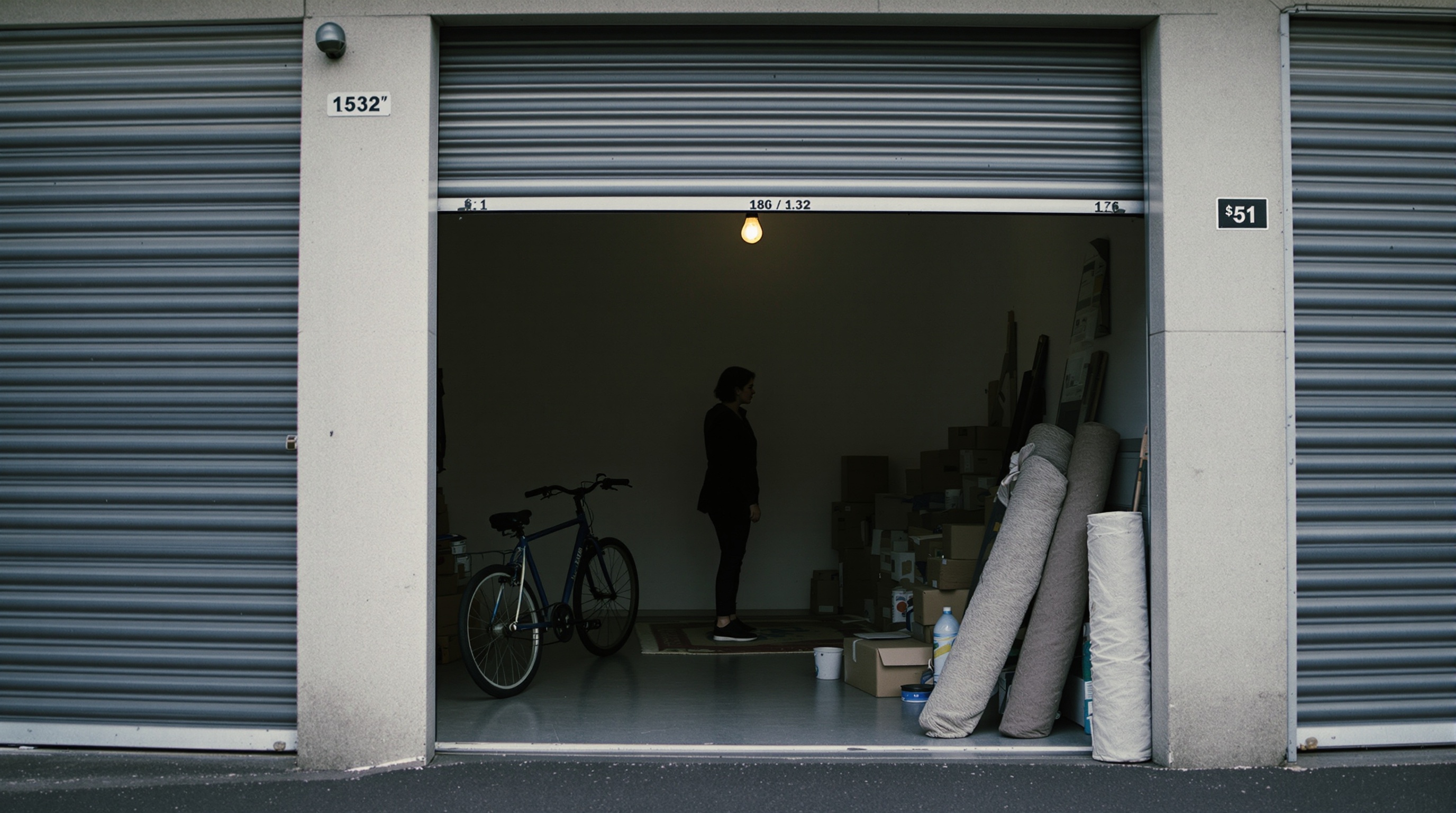
A self storage unit with the door half open
The client

Kestrel Self Storage

90 sites, roughly 40,000 units, competing entirely on price per square foot and postcode.

01

What they asked for

"We want people to feel something when they think about their storage unit."

02

What is really going on

Almost nobody rents a unit because they need space. They rent one because somebody died, a marriage ended, a business folded, or a house stopped fitting the life inside it. The category talks about price per square foot to people in the middle of the worst year of their life. Tenancies run far longer than customers expect, and not because they need the room. Going back means deciding.

03

The turn

Kestrel is not in the storage business. They are in the business of the decision people are avoiding. The moment they could own is the one nobody helps with: the day you finally open the door.

The idea

Unpack

Something you take into the unit with you. Point your phone at an object and say what it is. It listens rather than scans, and it asks you exactly one question, never more. Quietly it builds two lists, keep and let go. At the end it cuts a short film of the things you decided to let go of, so you still have them.

The draw

Spin for your client

Add your teams, then spin once for each. Every brief drawn comes off the wheel, so no two teams end up with the same client.

Step one

Who is drawing

Add your teams and the wheel hands each one a client in turn, so nobody draws twice and no brief goes out twice. Skip this and the wheel still works, you just claim briefs without a name attached.

Waiting

Hit spin. You get whatever you get. No swaps, no negotiating, no "can we have the biscuit one instead".

Every brief on this wheel has a genuine, transferable marketing problem hiding inside the silly bit. Find that, and the idea writes itself.

Click any pill to claim a brief by hand, or to hand one back if a team needs a re-draw.

The ten briefs

Ten clients nobody should take

Each one is a real marketing problem wearing a ridiculous costume. The ask is what the client said. What's really going on is what they meant. Solve the second one.

The toolkit

What you have to play with

Google has shipped an entire creative stack over the last year and most of it has never been opened by anyone in this room. Design, working software, video, and music, all of it promptable, all of it free or nearly free to try.

There is no expected workflow and no right combination. Use one of these, use all five, or use none of them and film something on a phone. The only thing being judged is whether what you show us is interesting.

Google Stitch

Interfaces from a sentence

stitch.withgoogle.com

Describe a product, or upload a photo, and it designs the screens. It responds better to a feeling than to a wireframe, so "premium and quiet, like Stripe crossed with a spa" gets you further than a list of components.

  • Generates whole multi-screen flows, not just one page.
  • Voice canvas lets you talk to the design and it asks you questions back.
  • Exports to Figma with layers intact, or straight to HTML and CSS.
Google AI Studio

Software that actually responds

aistudio.google.com · Build tab

Describe an app and it builds one, with Gemini underneath doing the thinking. This is where an idea stops being a picture and starts doing something to whatever you feed it.

  • Live API for real-time voice, so people can talk to the thing out loud.
  • Nano Banana 2 Lite for images in about four seconds. Gemini Omni Flash does video, but only on the paid API tier, so use Flow for that on the day.
  • Google Search grounding, Firebase for accounts, and a shareable link so a room can open it on their own phones.
Gemini Omni

Anything in, video out

Gemini app on AI Plus, Pro or Ultra · inside Flow · YouTube Create

Feed it text, a photo, audio or existing footage and it generates video back. The part worth knowing about is conversational editing: you change a shot by asking, and each instruction builds on the last one instead of starting over.

  • "Make the room warmer, slow the camera down, take the logo off the wall." Then keep going.
  • Noticeably better at physical plausibility, so gravity, momentum and liquids behave.
  • Draws on Gemini's own knowledge, so it can be asked for something historically or culturally specific.
Google Flow

Veo with a director's chair

flow.google · 50 free credits a day on a personal account

The difference between this and a raw video prompt is continuity. You can extend a shot without losing the motion, and keep the same character or product across every clip rather than getting a new actor each time.

  • Camera controls give you the move directly instead of begging the prompt for it.
  • SceneBuilder extends an existing shot while the motion keeps running.
  • Save your ingredients, so people, places and props, and reuse them.
  • Credits are the currency: Veo 3.1 Lite costs 10, Fast costs 20, Quality costs 100, so Quality is out of reach on the free tier.
Flow Music

The bit everybody forgets

flowmusic.app · free daily credits · sign in with a personal Gmail

Lyria 3 Pro writes full tracks up to three minutes with real structure, so intros, verses, choruses and bridges rather than a looping thirty-second bed. It will also remix the same song into a completely different genre, which is a fast way to show one idea landing with three different audiences. Sound is the cheapest thing you can add and the thing most likely to be skipped.

  • Three-minute maximum per track, and the free tier runs on daily credits.
  • Every track carries an inaudible SynthID watermark, worth knowing if anyone asks whether it is client-safe.
  • Also the quickest route to a radio ad, a jingle, or a sonic identity nobody asked for.
Before Monday

Sign in to all five

Ten minutes of logins on the day is ten minutes you do not get back. Stitch gives 350 standard generations a month per account and 50 experimental.

The real constraint

Video is the thing you run out of

Flow gives 50 free credits a day, refreshed on first use. That is five short Lite clips, or two Fast ones, per person per day. Plan your shots on paper before you spend any of it, and pool the team's accounts.

Check first

Flow on a work account is not guaranteed

Flow is an additional Google service, so it only appears on an Algomarketing account if Additional Google Services is switched on in the admin console. A personal Gmail always works. Flow Music wants a personal Gmail too.

Watch out

AI Studio will not make video for free

Video generation is paid-tier only on the Gemini API, at roughly ten cents a second. Everything else in AI Studio, including images and the Live API, is free. Do the video in Flow.

Watch out

Stitch cannot animate

No motion, no micro-interactions, HTML and CSS only. If your idea lives in movement, build it in AI Studio or shoot it in Flow.

Watch out

Stop arguing with it

Three failed prompts in a row means the model has locked onto the wrong shape. Do not negotiate. Start again with a longer, more specific first prompt.

And the rest

Everything else is fair game

The five Google tools are a starting point, not a boundary. Any free tool is allowed. If something out there would make your idea land harder, go and get it. Below is where to start looking, by the job you need doing rather than by brand.

Free tiers move constantly, so check what you actually get before you build your whole demo on one.

Still images

Ideogram, Krea, Leonardo, Recraft, Adobe Firefly. Worth having a second one open when Nano Banana keeps giving you the same face.

Video

Kling, Hailuo, Luma, Runway, Pika. Most give you a handful of free generations a day, which stacks nicely on top of your Flow credits.

Voice and speech

ElevenLabs, Cartesia, Play.ht. A convincing voiceover does more for a sixty-second film than another hour of picture.

Music and sound

Suno, Udio, Stable Audio. Different flavours to Flow Music, and worth a look if you want something scrappier.

Design and interfaces

Figma, Canva, Framer, and Spline if your idea wants to be three-dimensional. All have real free tiers.

Building and shipping

Replit, Lovable, Bolt, v0. Vercel, Netlify or GitHub Pages to put it on a link the room can open.

Research and thinking

Perplexity, NotebookLM, Claude, ChatGPT. Drop your brief into NotebookLM and have it argue with you about what the client actually meant.

Showing the thing

Loom or OBS to record a screen, Flourish or Datawrapper if your idea needs a number to land, HeyGen if it needs a presenter who does not exist.

Or just ask

You will not find the best tool for your idea on a list somebody wrote in advance. Ask an AI to go and find it. Steal the prompt underneath.

Steal this prompt

"I need a free tool that [does the specific thing]. I have no budget and about two hours. Give me five options with a genuine free tier, tell me the real limits, flag which ones need a credit card, and rank them by how fast I can get a usable output. I have never used any of them before."

What wins

One prize, two nods

This is an ideas day. Nothing is being judged on polish, feasibility, or whether the code holds together for a second run.

The prize

People's Choice

The one everybody wants to see again. Voted by the whole room at the end, one hand each, no abstaining and no explaining yourself. Whatever wins, wins.

Recognition

Most Ambitious

For the team that reached furthest, whether or not it held together on the day. Reach beats safety, every time.

Recognition

The Double Take

For the idea that made the room go quiet, and then go "wait, what?"

The obvious question

Enjoyed this? Luke will run it for your team.

Same format, your industry, your people. Half a day, no slides, and everybody leaves having built something they did not think they could. It works as a team day, a leadership offsite, or as the answer to "we should really do something with AI".

Email Luke about running this

Or just write to luke@algomarketing.com.